
If you process pistachios, almonds, cashews, walnuts, or pine nuts, you already know the nightmare: your roasted, sorted, premium-grade nuts go into the packaging line looking perfect — and come out in bags with cracks, splits, chips, and fine powder. Customers open the bag and see broken pieces instead of whole nuts. They leave bad reviews. They switch brands. And your premium product gets downgraded to a lower grade sold at half the price.
The problem is not your roasting. It is not your sorting. It is your packaging line. Standard packaging machines — built for hard granules like candy or seeds — treat fragile nuts the same way they treat gravel. High-speed vibration feeding, free-fall drops onto hard metal surfaces, aggressive bucket transitions — every step is an opportunity for impact damage. And when you are running 500–2,000 kg per day, even a 3% breakage rate means thousands of dollars in downgraded product every month.
The good news: a properly configured fragile nut packaging machine can reduce breakage to under 1% while maintaining high output speed. The key is understanding where damage happens and choosing equipment engineered specifically for gentle nut handling.
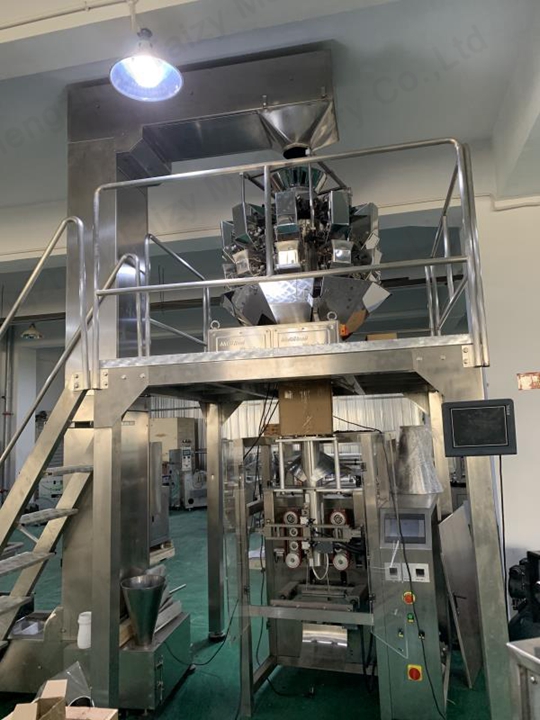
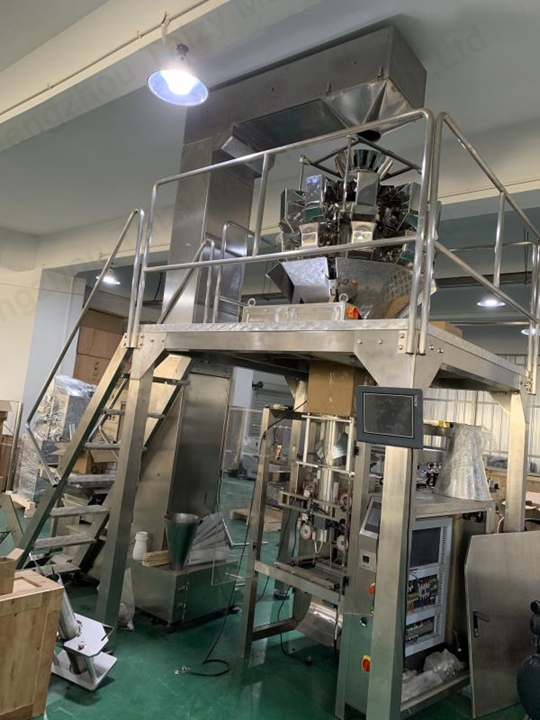
Why Nuts Break During Packaging — and Why It Costs You More Than You Think
Nuts are not like other granular products. Their structure makes them uniquely vulnerable to mechanical damage:
- Pistachios have naturally split shells that can crack further under impact, loosening kernels from the shell
- Almonds have a rigid shell that can chip and splinter, creating shell fragments mixed with kernels
- Cashews are soft and brittle — even a small drop can split a whole kernel into two pieces
- Walnuts and pecans have irregular shapes that create uneven pressure points during conveying
- Pine nuts have thin, delicate shells that shatter easily under any mechanical stress
The commercial impact is significant. Whole premium-grade almonds might sell for $8–12/kg, while broken pieces sell for $3–5/kg. A pistachio processor running 1,000 kg/day with a 5% breakage rate loses approximately $250–350 per day — or $75,000–105,000 per year — purely from downgraded product. And that does not count the customer complaints, returns, and brand reputation damage.
Industry data shows that breakage rates above 3% are common with standard packaging equipment, while purpose-built fragile nut systems can achieve rates below 1%. That 2% difference, on a 1,000 kg/day line, translates to $50–70/day in recovered product value — paying back the machine investment within months.
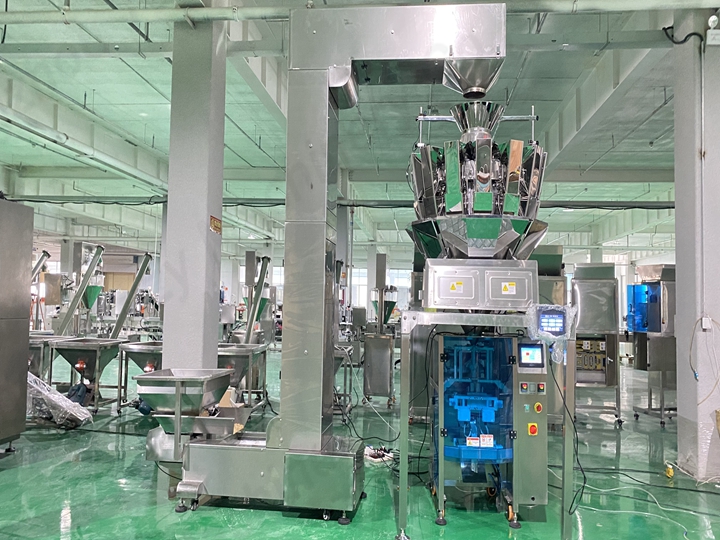

How Does a Fragile Nut Packaging Machine Differ from Standard Equipment?
A fragile nut packaging machine is not just a standard VFFS machine with a “gentle mode” button. It is engineered differently at every critical component:
| Компонент | Standard Machine | Fragile Nut Machine |
|---|---|---|
| Elevator buckets | Open steel buckets, hard surface | Deep buckets with food-grade PU lining, cushioned surface |
| Bucket transfer | Direct drop at bend points | Step-fed transfer with intermediate guide plates, reduced drop height |
| Weigher type | Linear vibration weigher | Multihead combination weigher with gentle vibration or bucket-type |
| Vibration frequency | 40–60 Hz, high amplitude | 15–25 Hz, low amplitude, step-wise feeding |
| Hopper surface | Stainless steel 304 | Stainless steel 304 with PU or PTFE coating, rounded corners |
| Drop to bag | 40–60 cm free fall | 15–25 cm drop with baffle plate or telescopic chute |
| Seal area clearance | Fixed | Adjustable, with product settling vibration before seal |
The fundamental difference is philosophy: a standard machine is designed to move product fast. A fragile nut machine is designed to move product fast without breaking it. Every component is selected and tuned to minimize impact, friction, and free-fall distance.
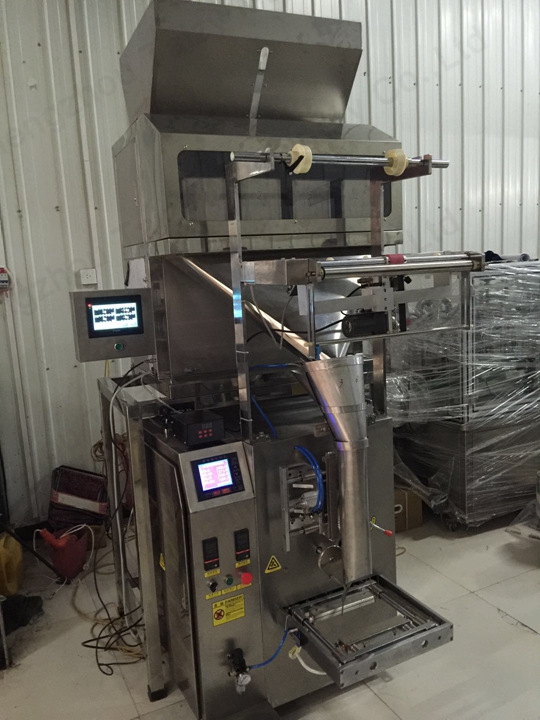
Multihead Weigher vs Linear Weigher: Which Is Better for Fragile Nuts?
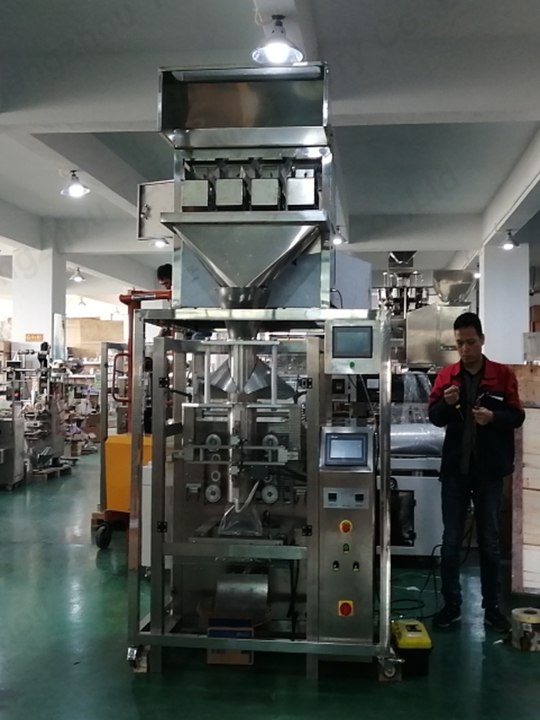
The choice of weigher is one of the most critical decisions for a fragile nut packaging line. Here is how the two main options compare:
Linear Weigher:
- Uses a vibrating trough to move product into a weigh hopper
- Simpler, cheaper, fewer moving parts
- Suitable for hard, uniform products like candy or coffee beans
- Problem for nuts: high vibration frequency causes bouncing and collision
- Typical breakage rate for pistachios: 3–5%
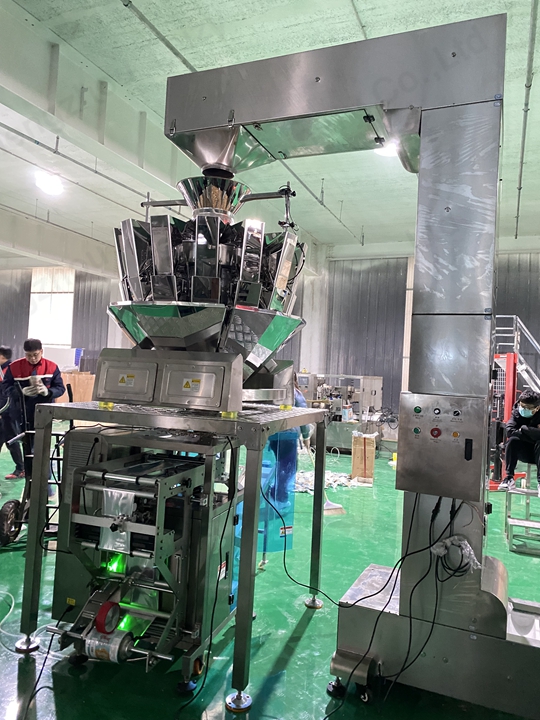
Multihead Combination Weigher (10 or 14 head):
- Uses multiple small weigh hoppers that combine to reach target weight
- Each hopper receives a small portion — less mass per drop, less impact
- Can run at lower vibration amplitude because small portions settle faster
- Step-weighing mode: fills hoppers to 30–50% of target, then combines 2–3 hoppers
- Typical breakage rate for pistachios: 0.5–1.5%
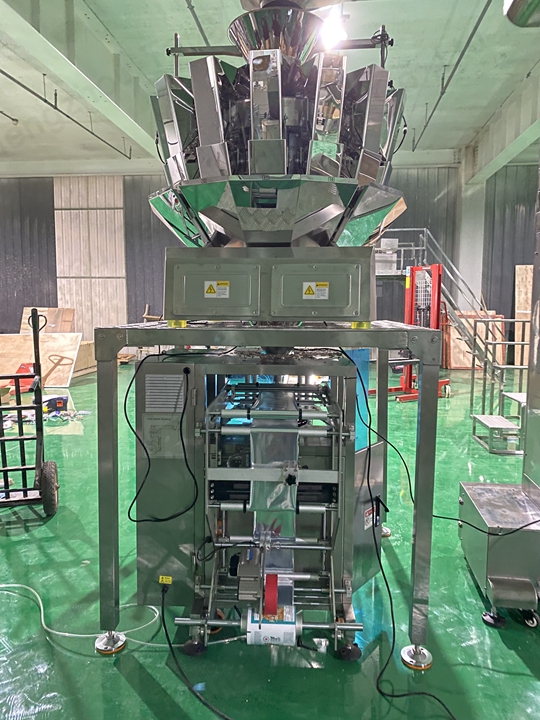
For fragile nuts, a 10-head or 14-head multihead weigher with gentle vibration settings is strongly recommended. The combination weighing principle means each hopper only holds a small portion of nuts, so when they discharge into the bag, the drop weight is lower and the impact is reduced. Additionally, multihead weighers achieve ±0.1–0.5g accuracy, compared to ±1–2g for linear weighers — meaning less product giveaway and more consistent bag weights.

ROI: How Much Does Breakage Actually Cost You?
Let us put real numbers to the breakage problem. Consider a mid-size pistachio processor running 800 kg/day, 250 days per year:
| Factor | With Standard Machine (3% breakage) | With Fragile Nut Machine (0.8% breakage) |
|---|---|---|
| Daily throughput | 800 kg | 800 kg |
| Broken product per day | 24 kg | 6.4 kg |
| Whole nut price | $10/kg | $10/kg |
| Broken piece price | $4/kg | $4/kg |
| Daily value loss from breakage | 24 kg × ($10–$4) = $144 | 6.4 kg × ($10–$4) = $38.40 |
| Annual value loss (250 days) | $36,000 | $9,600 |
| Annual savings | — | $26,400 |
Now add secondary savings:
- Reduced product giveaway: Multihead weigher accuracy of ±0.5g vs ±2g linear weigher saves approximately 1.5g per bag × 2,000 bags/day = 3 kg/day = $30/day = $7,500/year
- Fewer customer complaints and returns: Estimated $3,000–5,000/year
- Higher premium-grade yield: More whole nuts means more product sold at premium price
Total annual benefit: $36,000–40,000 — which typically covers the cost of upgrading from a standard to a purpose-built fragile nut packaging line within 12–18 months.
Ready to Stop Losing Money to Nut Breakage?
If you are processing fragile nuts and seeing more than 2% breakage in your finished bags, your packaging machine is costing you money every day it runs. A purpose-built fragile nut packaging machine can reduce breakage to under 1%, extend shelf life with nitrogen flushing, and improve weighing accuracy — all while maintaining the output speed your production schedule demands.
Tell us about your operation, and we will recommend the right configuration:
- What nut varieties do you process? (pistachios, almonds, cashews, walnuts, pine nuts, mixed)
- What is your daily processing volume? (100–500 kg / 500–1,000 kg / 1,000–2,000 kg / 2,000+ kg)
- What bag sizes do you need? (50–100g snack bags / 200–500g retail bags / 1–5kg bulk bags)
- Do you need nitrogen flushing for export or extended shelf life?
- What bag format? (pillow bag / gusseted/stand-up pouch with zipper)
- Do you need a complete line or just the packaging machine?
Contact us today for a free consultation and quotation. Our team will review your product characteristics, throughput requirements, and packaging format to recommend the optimal fragile nut packaging solution — typically within 24 hours.